
propagating Arisaema (pronounced air-uh-SEE-muh)
My love affair with Arisaema species began many years ago when I met Susan Kierstead, owner of Perennials from Susan. With her extensive background in botany and plant propagation, Susan introduced me to the secrets of many spring ephemerals that she grew on her southern New Hampshire property. I will never forget bringing home my first corms from Susan’s garden: A. triphyllum (native) and A. sikokanium (Japan). The plants were dormant and I was to just plant the tiny corms in rich organic soil in a shady location. She explained the plants’ lifecycles to me and the following spring I anxiously awaited for each to emerge, grow, become pollinated and produce a seed head (they did!!).
Planting my first seeds from my very own plants and cultivating them for years until they bloomed was a real joy. Yes, it’s slow art and requires lots of patience. But the rewards are many and grow with each passing year as my colonies expand from one, to three, to five and beyond!
Arisaema begin to emerge as salmon colored spotted points in the soil in late April and unfurl in May with their curious striped spathe (pulpit) protecting the spadix (Jack) inside. Unlike a ‘typical’ perennial that is pollinated by bees and wasps, Arisaema are pollinated by tiny fungus gnats.
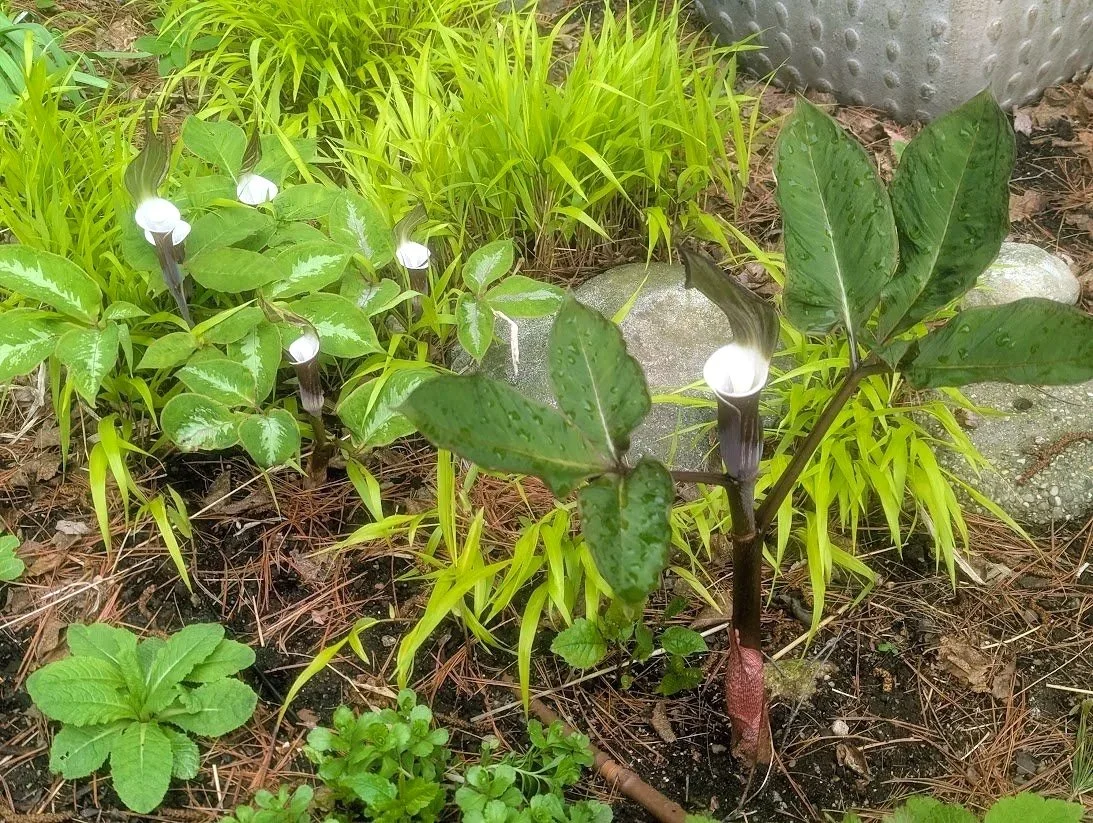
These curious plants can actually change sex from year to year! In 2026, one of my original Jacks that was probably 10+ years old and originally a male grew to enormous height and size. I learned that in all likelihood, the plant switched from male to female (photo at top of page shows the female on the right, much larger than the males on the left).
Arisaema propagation
If an Arisaema plant is pollinated, it will produce a sizeable green seedhead that grows as the plant slips into dormancy. It is important not to harvest the seedhead until late fall or early winter when the seed berries have turned red. At this point, the gardener can either break apart the seedhead and disperse around the garden, or if more control is desired, manually separate the berries, remove the gelatinous covering to expose the seeds and then stratify to plant them later in pots to start indoors.
I typically gather the seed heads in November and put them in a dry container in the garage until I’m ready to harvest the seeds, which could be a month later. The key is to gather the seed heads before they get covered in snow which could be anytime after Thanksgiving here in southern NH. Be sure to wear gloves when handling the seed heads as they contain calcium oxalate crystals which can be highly irritating!
The timing is perfect for family to help me clean the seeds as we gather for the Christmas holidays. Wearing protective disposable gloves, we each grab some red berries and squish them around in a bowl of water, releasing the seeds inside. The gelatinous substance separates from the seeds which are then retrieved from the bowl and laid out on paper towels.
I then roll up the paper towels with seeds inside and put them in a plastic bag and refrigerate for 4-6 weeks. This simulates the stratification process that would naturally occur out in nature and breaks the seeds’ dormancy. Some time in late January or early February, I remove them from the fridge and carefully pot up for growing on indoors. I find that 3 or 4 seeds per 4”x4” pots works really well. I like to top the pots off with a very light layer of coconut coir.
Place the pots on trays on top of heated grow mats (around 70 degrees) until germination occurs, usually in about 4 weeks. Once seeds have germinated, it’s important to remove them from the heat and grow on under lights. You can find high quality supplies from Gardener’s Supply, Bootstrap Farmer, or Johnny’s seeds including seed starting soil, pots, trays, lights and more!
what to expect as your jacks grow
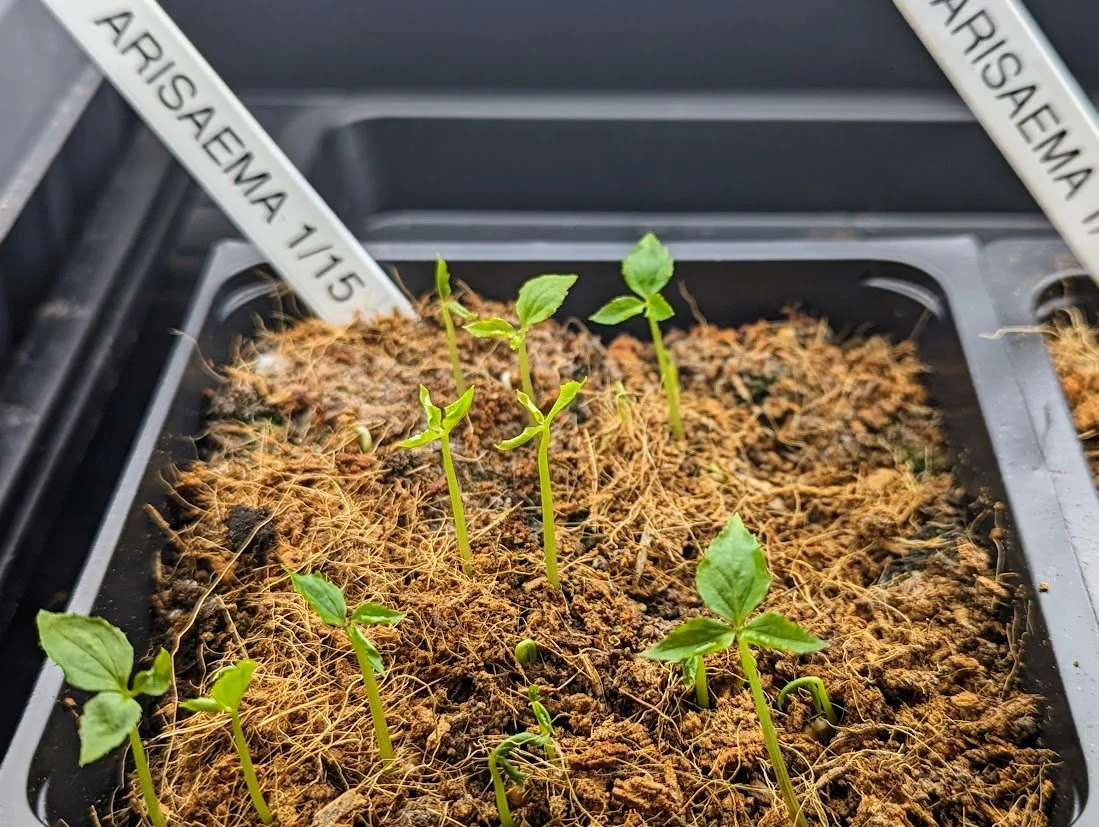
Arisaema sikokianum seedlings 2/24/24 (planted 1/15/24)
Be patient, as germination can take 4 or more weeks. Once they peek through the soil, they grow quickly. These Jacks were planted on January 15th and seedlings were already one inch tall by February 24th! But, this is about as tall as they will get in year one.
It’s important to note that bottom watering is critical for any seedling, and this is no exception. Invest in sturdy shallow seed trays to hold your pots and fill the tray with water, allowing the pots to absorb from below. This helps to keep seeds from being disturbed and potentially washing out of the pot. It also minimizes disease and fungus. Do not let pots stand in water for more than a couple hours! You don’t want them to rot!
Seedlings will grow to 1-2” tall with just one 3 leaf set in year one. Don’t expect much more of them right now. They are putting energy into developing their corms and will grow slightly larger next year. I usually keep my Jacks in their pots until fall and then carefully plant the tiny corms out into the garden, being careful to mark their location. In year two, they will still be small, but growing!
By year three, they should start to look more like a plant and if you are lucky might even produce two opposing 3 leaf sets, followed by a spathe and spadix. However, with A. sikokianum, it has taken me 5 years to achieve bloom.
winter seed sowing
Originally, I did all my Arisaema seed sowing in dedicated shallow planters (think large round plastic pond tubs you can get a Lowe’s on left). I punched some holes in the tubs, filled them with sterile potting soil to minimize weed seed competition, and covered with 1/4” mesh wire to keep rodents and birds out. I seeded after Christmas and kept the tubs outside all year in a shady quiet space behind my shed and compost pile.
This ‘nursery’ method allows nature to be in control of temperatures and moisture and I believe it produces the heartiest of plants. I monitored the seedlings annually and when it looked like they were ready to produce blooms, I gently lifted them up and transplanted into the garden. Note the various stages of maturity of seedlings in the nursery tub.
This proved to be a very successful and low maintenance method, skipping the need for pots, trays, heat mats and lights! This year, I will probably do both indoor and outdoor methods!